Centro Risonanze Magnetiche (CERM), Department of Chemistry,
Advanced NMR Research at CERM: Deciphering S. aureus SOD Heterodimers
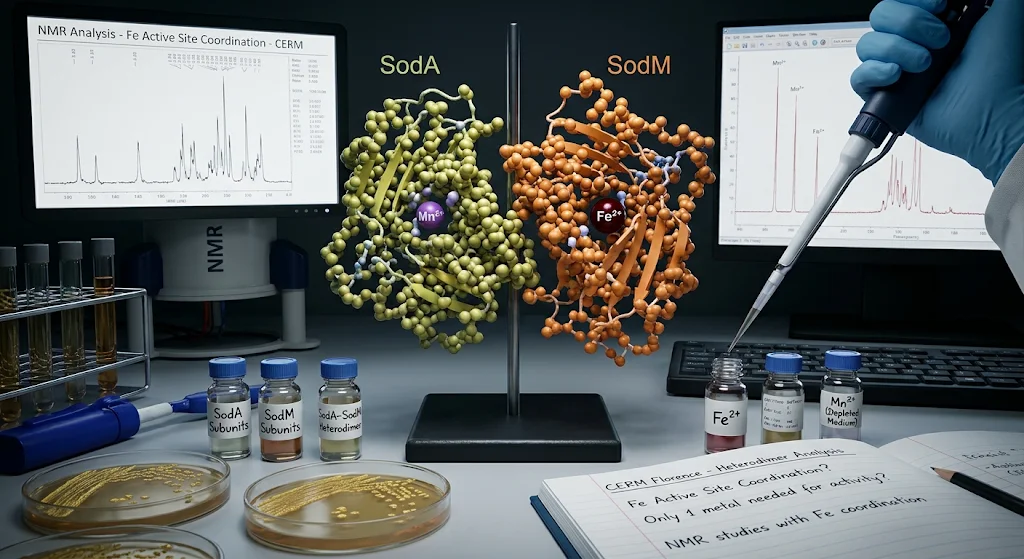
Staphylococcus aureus is an antibiotic resistant pathogen with multiple means of circumventing the immune defence of the host. Locally, the tissue of the infected host will react to infection by withdrawing the nutrients necessary for metabolic cycles, such as manganese, while simultaneously bombarding it with reactive oxygen species. S. aureus has evolved to have two enzymes catalysing the conversion of superoxide radicals to molecular oxygen and less harmful hydrogen peroxide to protect itself from these attacks. Primary superoxide dismutase is manganese dependant, with high catalytic rate, but in case of manganese withdrawal from the environment, it will switch to express cambialistic Sod (SodM) which can utilise both manganese and iron. These two molecules in the same environment will also form a third, containing one half of SodA and one half of SodM, they are called heterodimers and can be loaded with mixed active/inactive metals. I am studying the heterodimeric form to evaluate whether it is necessary for this enzyme to have two active metal molecules to achieve activity. Biochemical analysis of the heterodimeric forms show that only one active metal is needed for the enzyme to be active. To assess the events on the active site and to determine whether the two metals of the active sites coordinate each other, more advanced biophysical methods were necessary. During my visit to CERM I worked with the leading experts in nuclear magnetic resonance (NMR) to determine the events around the iron coordinated in the active site of one half of heterodimeric molecule. I received training in a new technical skill and enhanced my ability to work in an international and interdisciplinary research environment. I have expanded my research capabilities, gained valuable insights for my PhD topic and have established new connections.
Lorna Nikolic
PhD Student • IBB